

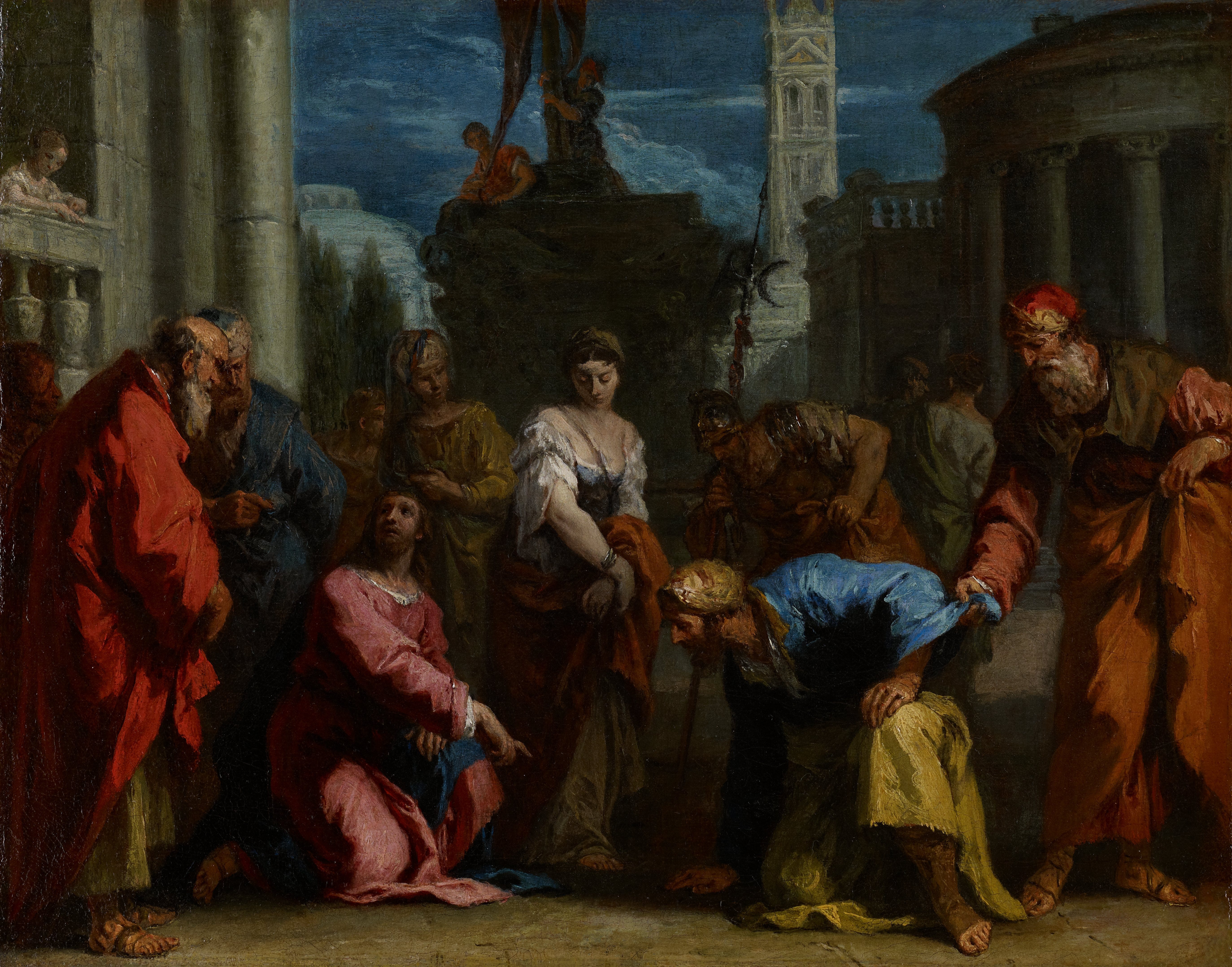
Chapter eight of the Gospel of John tells of a woman caught in adultery. She has violated the law of Moses and the punishment is death. The scribes and Pharisees use her sin to test Jesus. Should they stone her to death? If he says not to stone her, Jesus violates the law of Moses. If he approves their actions, he violates Roman law. Jesus gives no reply. He only writes in the sand. We know not what.
He finally speaks, “Let those among you who have no sin cast the first stone,” and continues writing. One by one the accusers drop their stones and leave. The guilty woman is left alone, only with Jesus. Ashamed and in fear for her life she looks to Jesus. He asks her, “Is there no one here to condemn you?” She responds, “No one sir” to which Jesus replies, “I do not condemn you. Go and sin no more.”
As we see with Eve in the garden, the devil and the world will entice, confound, and encourage to lead us into sin. Do what you desire. There is nothing to worry about. The commandments are a hindrance to your self-actualization. Shame and guilt are contrived to prevent your happiness.
Yet at some point the inescapable realization sets in. We have done evil. We have used and abused ourselves and others. We are overcome with the heat of guilt. Not just in mind, but in our body: a flinch, a desire to hide, to run, to do anything rather than face our offenses. More distraction, more sin. Just don’t make me look at myself. We search for an excuse (the woman you put here, she gave it to me!). We try to justify. But when we can no longer escape, we arrive at a point, both terrible, and yet with a sense of a beginning. I have done wrong. It is my most grievous fault. The only real option that stands before me is repentance and change. Here the devil and the world appear again. Up to now evil has been treated with indifference. But now comes condemnation. What evil you have done! What a shame you are. Well, it is to be expected, that’s just who you are. You are a liar, a thief, a slut. You’re gay, you’re trans, an addict, a felon. You’re impatient, lazy, stupid. That’s who are. You are cancelled. Repudiated. There is no forgiveness. Stuck in your shame. It is too late for you.
But that is not the only maneuver. There is another, more insidious, cloaked in compassion. Affirmation. In contrast to the condemners who tell you how bad and unredeemable and beyond hope you are, the affirmers come with the softer message. It’s okay. There’s nothing wrong with you. You are authentic. Follow your passions. Everyone needs self-care. You deserve this. Who are those people to judge? That’s just who you are. You are a liar, a thief, a slut. You’re gay, you’re trans, an addict, a felon. You’re impatient (now we’ll call it driven) lazy, stupid. You can’t change who you are. And anyone who tells you differently is mean, self-righteous, judgmental, a hypocrite. They secretly want to do those same things. Be who you are! You are welcomed here. Affirmed. There is no need for repentance or forgiveness. Express yourself. It’s your identity. Be proud of yourself. Don’t listen to haters.
It is the same message: it’s too late for you. Only now in a soft, pharmacological, therapeutic tone.
Like the woman in the Gospel, we are surrounded by condemnation and affirmation. And yet we are still alone.
But not entirely.
In our silence, ashamed, confused, unable to look at ourselves, unable to lift our eyes, there stands Jesus. And if we listen, we will hear his voice. But we are afraid because we will hear the question we cannot bear, “Is there no one here to condemn you?” More than any other voice, we fear condemnation from God. He is our one last hope, and we cannot bear to lose it. Better not to take the risk. But if we do, and like the woman reply in fear and trembling, “No one but you, sir,” what will Jesus say?
He who knows our sins and feels the offense of evil greater than anyone else, he who is holy, the spotless lamb.: what will he say and can we bear it? He replies like he did to the woman, “Neither do I condemn you. Go and sin no more.”
Jesus neither condemns nor affirms. He forgives and tells us the truth. You are not condemned. Go and sin no more. This life is not for you. This is not who you are. You are a sinner, this is true. But you are not your sin. You are wounded, confused. But you are not your wound. You are not your confusion. That is the lie. Your worth, your life, and your meaning is not determined or identified by your sins or your wounds. You are not a liar, a thief, a slut. You are not gay, trans, an addict, felon, a prostitute, or a pimp. You are not impatient, lazy, stupid. You are loved. You are redeemed. You are my son. You are my daughter. Just as Jesus spoke to the woman so he says to us: Rise up. Let’s go. Do not be afraid. Stay no longer in your sin. It is the same message he gave to Abraham, “Go forth!” You cannot stay here. You cannot remain in your old life. It is the message to Israel – it is time to go, to leave Egypt. It is the message to Peter, James, and John on Mount Tabor, “Rise up, don’t be afraid.” It is the message to Peter after his denial. It is the message of St. Paul, “forgetting what lies behind, reach forward”
In The Shattering of Loneliness, Bishop Eric Varden writes in his meditation on “Remembered Lot’s Wife,” we are not meant to stay where we are. We are called for more. He quotes St. Bernard, “Not to move forward on the path of life is to slide back,” and St. John Henry Newman, “to be at ease, is to be unsafe.”
We must move. No doubt we will fall again. Like with Israelites, God will either shield us from the Philistines or save us from Pharaoh. Each of us is a sinner. Each of us in need of repentance and change. And each of us has agency and grace and therefore the capacity to change. The condemners and the affirmers say, “That’s who you are. Stay There.” But Jesus tells us that we are made for more. The Paschal season is upon us. Repent. Rise up. Do not be afraid. Let’s go.
I enjoyed your article, and agree that sometimes, Jesus neither condemns nor affirms. We need to learn to do most of the judging of our own character that needs to happen in the heart of a disciple.
Your article conveyed the side of Jesus that it seems to me, Jesus shows to all of the people of the world who have yet to encounter him ... a voice of hope and acceptance, of non-judgment and confident expectation of good results in due course ... at each person’s pace. That is refreshing compared to the messaging non-Christians get from so much of Christian “evangelism”: “If you don’t accept Jesus, you are doomed.” I think Jesus’ words in John 3:17 should suffice on this point. “God sent not his Son to condemn the world, but that the world through him might be made safe and sound.” The promise of the cross comes from its completeness, even for the enemies of Jesus. “Father, forgive them, for they know not what they do.”
But let me suggest a third option, when you pointed out the Pharisees’ hoped-for trap for Jesus: that if He said they not stone her, he would be in violation of the law of Moses.
There’s an obscure law of Moses on adultery that is seldom considered: the situation described in Numbers 5 in which a husband suspects his wife of adultery, but cannot prove it.
It seems likely to me that Jesus knew they had no witnesses. Therefore, the Numbers 5 law was applicable. Remember his challenge to the crowd, “Let him who is without sin among you be the first to throw a stone at her.” Throwing the first stone was the duty of the two witnesses who had testified against a person in any capital offense. Two or three witnesses were required, and each of them were duty-bound to be the first to throw a stone if a guilty verdict was decided by the town council. When Jesus put forward that requirement, the crowd melted away. He had called their bluff.
By writing in the dust on the ground, Jesus hints at the Numbers 5 law applicability to the case. In such cases, the High Priest wrote down the evidence and charges. He then dissolved the ink containing those charges in a vessel containing water from the laver, in which all visitors to the Temple or Tabernacle, including the priests themselves, washed before entering the Holy for service in the presence of God. In this way Jesus was showing himself to be the High Priest, and he was also showing himself to be the water of Life.
In the Number 5 account, after the priest had dissolved the charges against the woman, he gathered dust from the floor of the Holy (first) chamber of the Tabernacle/Temple, and sprinkled that dust into the vessel along with the ink which had embodied the suspicions of the husband. Then the Priest gave the sullied water to the woman to drink.
Now the judgment was left to God. It could be likened to the crucible which Malachi wrote of, in which the “sons of Levi”, the underpriests, were examined and purified in a furnace of trials.
Jesus was teaching the Pharisees, and his own disciples, that we are always being purified and “made white” and tried in our daily life as disciples of Jesus.
In the Numbers 7 law regarding adultery, If the woman became pregnant and delivered a healthy baby, she was proven to have been cleared of sin by God himself ... the Judge who stood above even the High Priest as an authority in our lives. But if she developed a uterine disease or delivered a miscarriage, this was held to be God’s judgment that the woman had been guilty of adultery as the husband suspected.
I think Jesus knew that she was guilty, but showed that in his role as high priest, he had secured the power to deliver and exonerate any transgressor who repented. So he said to her, “Go and sin no more.” No doubt, she became a disciple of Jesus, and realized full forgiveness for all of her past sins.
The smelly part of the Pharisees’ challenge to Jesus in the John 8 account is the lie that they began with. “In our law she must be stoned.” No, in the law which required stoning, BOTH the adulterous man AND woman were to be stoned. But there had to be witnesses, and there had to be two guilty parties. Since no man was being charged, Jesus knew they were lying and did not have witnesses to implicate the man along with the woman.
The trial by fire which the Numbers 5 law demanded is a beautiful indication, it seems to me, of the course of action that any Christian can avail themselves of when they find that their bridegroom, Jesus, has reason to doubt their fidelity to Him. Often we fall short of our own statements of faith and belief. Often we break the commitments of our heavenly bridegroom, that we love one another, serve one another, lay down our lives for one another, believe his promises to us, etc. What can we do? Throw ourselves at Jesus’ mercy and submit to God’s judgment. Know that if we have a ready mind, we are not judged at the throne of Grace by what we don’t have, but by what we have. ALWAYS, we as Christians can enter BOLDLY to the throne of grace, to find more grace to help us in times of need. (Hebrews 10:19,20)
If we drink the water of purification, the word of Truth, it will sometimes be bitter to our taste, pointing out our sins as disciples of Jesus. And when we add to that mixture the dust of the Holy ... the place where both we and all the other underpriests do our daily chores of refreshing the bread of life and bringing prayers as incense upon the altar in the Holy, along with the blood of the sin offering that was offered for us ... that concoction reveals our worthiness of being found “faithful unto death”. By persisting in the work of service to all the other brothren iand sisters in Christ whom we remain in fellowship with, we satisfy the Heavenly Father that we have remained faithful to our calling into his family. We will be fruitful if persist in bearing fruit.
The apostle Paul described this idea in 1 Corinthians 3, where he says that if the work of our life as Christians is burned up, we suffer loss, but our spirit is nevertheless saved ... though perhaps through difficult trials. But if our life work as Christians survives the fire, it becomes apparent to us and our fellow-servants that our character is made up of gold, silver, and precious stones. Those gems of good character, Paul says, become the basis for God graciously rewarding us with additional joys of service in the next era, and the next level of existence promised to faithful Christians in the celestials.
Or, in the paraphrased words of Malachi, “God purifies the sons of Levi, putting them through a trial of fire in which the refiner looks to see his image reflected in the pure gold and silver that is refined in the furnace of life.”
I think Jesus does concern himself with our purity of heart, he does reinforce and reward our faithfulness ... but he also embraces us when we fail as perhaps that woman had done, and reinstates us as he did for her ... with a gentle admonition to “go forward. Keep going in repentance ... sin no more and experience fulness of joy on the other side of this difficult experience.”
He knew her heart, no doubt, and he knows all men and women who are serving him may stumble into sin because of the incompleteness of our character. What we need is not shaming, self-hate or discouragement. What we need is a pure resolve to learn from our mistakes and a commitment to trust the transformative process Jesus our High Priest, working with the Heavenly Father, can accomplish if we continue to walk with Him, and in fellowhip with our brethren in Christ.
As Paul put it in 2 Thessalonians 2:16-17 (Weymouth): “And may our Lord Jesus Christ himself, and God our Father who has loved us and has given us in His grace eternal consolation and good hope, comfort your hearts and make you steadfast in every good work and word.”
Sorry this comment was so long.... Loved your article.